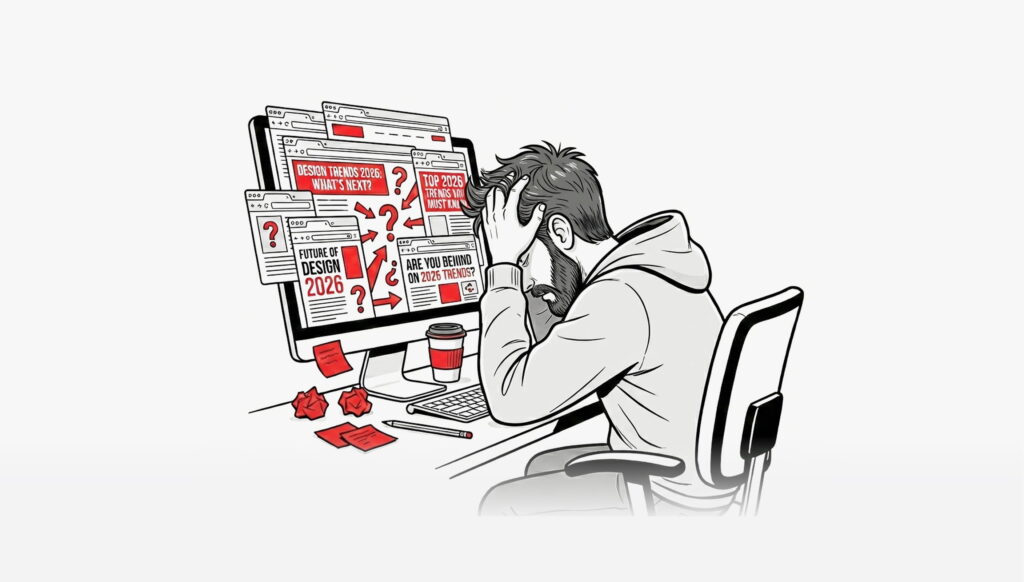
Every January, my inbox floods with the same thing.
“2026 Design Trends You MUST Follow!” “Top Design Trends for the New Year!” “10 Styles That Will Make or Break Your Product!”
And every year, I watch the same pattern unfold. Small agencies panic. Design teams scramble. Companies burn their energy (and budget) chasing whatever style Dribbble says is hot. Clients started asking questions. Managers started sharing links. Designers started doubting themselves.
And I caught myself thinking: “Am I already outdated?”
That feeling – it’s not about design. It’s about fear.
Let’s be honest about why we chase trends. Most people don’t chase New Year design trends because they love trends. They chase them because:
They don’t want to look old
They don’t want to feel behind
They don’t want to miss something important
I’ve seen teams redesign perfectly working products, not because users asked for it, but because the calendar changed. Here’s what nobody tells you: your users don’t care about your gradient choices.
When was the last time you used an app and thought, “Wow, this shadow is so 2025”?
Never, right?
You think about whether the app works. Whether it’s fast. Whether it solves your problem.
But we designers? We obsess over shadows and spacing and whether our buttons look “modern enough.”
Why? Fear.
Fear of missing out (FOMO) is real, especially in creative fields where being “current” feels synonymous with being good.
But here’s what I learned the hard way: following trends without understanding why is like copying someone else’s homework. You might pass, but you won’t learn anything.
What Trends Actually Are
Let me make this super simple.
A real trend is when lots of people start behaving differently. In the industry, trends aren’t just “what looks cool.” They’re data-driven forecasts of consumer behavior shifts. Companies like WGSN spend millions tracking these patterns using frameworks like PEST (Political, Economic, Social, Technological) because they represent real market movements.
Real Trend Example: Everyone’s using phones instead of computers. This is a real behavior change. You need to care about this.
Fake Trend Example: Some article says “neumorphism is hot this year!” But your users don’t even know what neumorphism is. You can ignore this.
Big research companies study real trends that last 5-10 years of economic shifts, new technology, social movements, political changes. But most “New Year trend” articles? They’re just talking about style changes. Here today, gone next year.
Focus on behavior changes, not style changes.
And no, real trends don’t magically reset on January 1st. People don’t wake up on New Year’s Day with completely different preferences. The calendar creates a psychological fresh start for us, what researchers call the Fresh Start Effect, but user needs evolve continuously, not annually.
The Real Cost Nobody Talks About
Here’s where it gets expensive.
Designers ask: “What’s new in design?” Users ask: “Why is this still hard?”
That gap costs money.
I’ve worked on projects where the UI looked beautiful, the animations were smooth, the style was “modern” and users still struggled. Because we designed for trends, not for thinking patterns.
According to Nielsen Norman Group, usability and clarity consistently outperform visual novelty when it comes to user satisfaction.
Pretty doesn’t mean helpful.
Research on small businesses reveals a brutal truth:
Energy drain. Your team rewrites code, redesigns interfaces, retrains workflows, all for aesthetic changes that may not impact the bottom line.
Brand confusion. When you shift your visual language every year, users can’t recognize you. Consistency builds trust. Constant change erodes it.
Missed opportunities. While you’re implementing the latest style, your competitor is quietly solving real pain points.
A 2025 study showed that companies prioritizing user research over trend adoption achieved 40% faster market entry and 25% higher customer satisfaction scores.
The math is simple: Knowing your users beats following trends.
What Teams Do
What Actually Happens
Redesign website for “freshness”
Users get confused by new navigation
Add AI features “because everyone has them”
Increases load time without solving problems
Copy competitor’s trendy UI
Loses unique brand identity
Follow design influencer advice blindly
Misses actual user context and needs
So… Should You Ever Follow Trends?
Okay, I’m not saying ignore ALL trends. Some trends happen for good reasons. Let me give you a simple test. I call it the “So What?” Test.
Someone says: “We should add this trendy feature!” You ask: “So what? How does it help our users?”
They say: “It looks modern!” You ask: “So what? Do users want modern or do they want easy?”
They say: “Um… I don’t know.” Your answer: “Let’s ask them first.”
Here’s when you should follow a trend:
1. When users are already changing Example: Everyone’s using phones now, not computers. So making your website mobile-friendly isn’t “trendy”—it’s necessary.
2. When it solves a real problem Example: Adding a dark mode because users said their eyes hurt at night. That’s good.
3. When your customers actually want it Example: Your users keep asking for a certain feature. Then you see it’s trending. Perfect match!
The trend confirms what users need. It doesn’t create the need.
Who Actually Sets Design Trends?
Here’s something uncomfortable truth:
Designers don’t set trends. Users do.
The companies we call “trendsetters” – Apple, Airbnb, Netflix. They don’t follow trends. They watch people.
Think about it.
When Apple added Face ID, was it because “facial recognition was trending”? No. It was because they noticed people hate typing passwords.
When Airbnb redesigned their app, was it to look modern? No. It was because people got confused finding their bookings.
Trendsetters solve problems. Followers copy styles. Real trends are discovered, not invented.
They start with economic pressure, cultural shifts, technology access, and emotional fatigue. Agencies like WGSN observe these shifts early, but even they don’t say “Change everything this year.” They say: “Pay attention.”
A Real Example: When “Modern” Made Things Worse
Gojek, a major company in Southeast Asia, redesigned their app to look like Western apps. Very trendy. Very modern.
Users hated it.
Why? Because it didn’t fit how Southeast Asian people actually use apps.
When Gojek redesigned based on local user behavior, simpler navigation, familiar icons, local languages – adoption soared.
The interface looked cleaner and modern, but beauty came first and understanding came later. That order matters more than any trend.
Want to become a trendsetter?
The simple 3-step framework. Want to stop following and start leading? Here’s how:
Step 1: Watch Real People Use Your Product
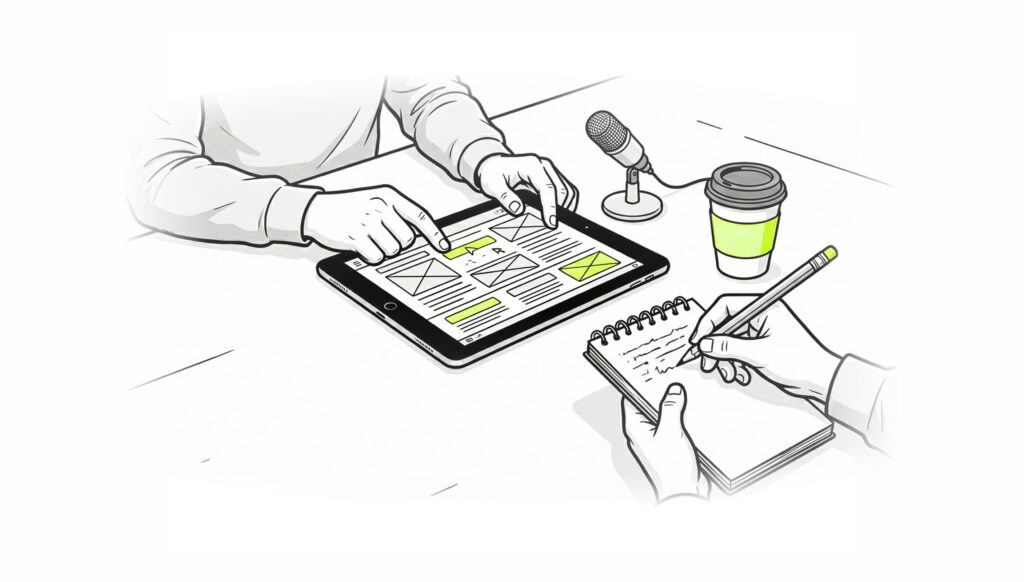
Not analytics. Real humans. Sit next to someone (or do a video call) and watch them use your website or app. Don’t help. Don’t explain. Just watch.
You’ll see things you never noticed: Where they get confused, what they skip, what makes them frustrated
I do this once a month. Just five people. It teaches me more than a hundred trend articles.
Step 2: Ask Better Questions
Instead of “What’s trending?” ask:
“What’s frustrating our users right now?”
“Where do people waste time?”
“What would make their day easier?”
These questions lead to real innovation.
Step 3: Test Small Before Going Big
Never redesign everything at once. Change one thing. Test it. See what happens.
The 2026 Trends That Actually Matter
Okay, you might still be wondering: “But what about real 2026 trends?” Fair question. Here are trends based on actual behavior changes, not style preferences:
1. Real Personalization
What this means: Users want products that feel made for them. What this doesn’t mean: Adding their name to an email and calling it “personalized.” What you should do: Learn what your specific users need and build for that.
2. Accessibility as Standard
What this means: 1 in 5 people have some disability. Your product should work for them. Why it matters: It’s the right thing to do. Plus, it makes your product better for everyone. What you should do: Test your product with people who use screen readers or have limited vision.
3. Environmental Transparency
What this means: Younger users especially want to know if your company cares about the planet. What this DOESN’T mean: Adding a “we care about earth” page with no real action. What you should do: Be honest about your impact and share real steps you’re taking.
4. Humans Over Robots
What this means: As AI content floods everything, people crave real human touch. What you should do: Show your face. Share your story. Be imperfect. Be real.
Notice something? All these trends are about understanding what people want, not copying what looks cool.
Your Simple Action Plan
Here’s my honest conclusion. Don’t follow trends. Don’t fight them either.
When you do that long enough, you won’t chase trends. You’ll create one.
Let me make this super practical. Here’s what you should do starting today:
Every Month:
Talk to 3-5 users (can be casual, like a phone call)
Watch someone use your product
Read your support tickets—what are people complaining about?
Before Copying Any Trend:
Ask: Does this solve a problem my users actually have?
If yes: Test it small first
If no: Don’t do it (save your energy)
For Your Team:
Share one user story every week in team meetings
Celebrate solutions, not just pretty designs
Measure results, not just implementations
The 5-Question Framework.
After my big mistake, I created a simple checklist. Before making ANY design decision, I ask these five questions:
What human need does this address? If you can’t answer this, stop
What proof do we have that this need exists? User interviews? Support tickets? Data?
How will we test if this works? Never launch without testing
Does this help our business goals? Beauty is nice, but we need results
Can we maintain this long-term? Don’t build what you can’t sustain
If you can’t answer all five, don’t build it. This saved me from countless mistakes. It’s not fancy. But it works.
What We Should Learn to Be “Trendy”
How do we stay valuable as tech professionals? Here’s what I wish someone told me when I started:
Don’t try to stay trendy. Try to stay useful.
The most valuable professionals aren’t the ones who know every new framework or design style. They’re the ones who understand people and can:
Talk to users and understand their problems
Build solutions that actually work
Explain why something is good or bad
Think critically about trends instead of blindly following them
Skills That Never Go Out of Style:
Understanding human behavior (psychology, decision-making, frustration points)
Communication skills (explaining simply, listening, asking good questions)
Problem-solving mindset (testing ideas, learning from failures, staying curious)
Business thinking (how companies make money, what metrics matter)
These skills worked in 2006. They work in 2026. They’ll work in 2046.
Why? Because people don’t fundamentally change. Technology changes. Style changes. But human needs stay similar.
Master the basics of understanding people, and you’ll never worry about trends again.
My Final Thoughts
The Question That Changed Everything
Three years ago, I was obsessed with being trendy. Every morning, I’d check Dribbble before even having coffee. I read every “trend prediction” article. I worried constantly about being outdated.
I was exhausted. Then came that expensive failure. My lead designer asked one simple question:
“Why did you do this?”
I had no good answer. That question hit me hard. Because I realized I had no real reason. I was just following. Just copying. Just trying not to be left behind.
Then something sparked in my mind. A teaching I’d heard years ago but never truly understood until that moment.
Islam strongly discourages blind imitation and urges Muslims to act with awareness, purpose, and independent judgment. The Prophet ﷺ warned against being a mere follower of trends without discernment:
“Do not be a mere follower, saying: If people do good, I will do good, and if they do wrong, I will do wrong. But discipline yourselves: if people do good, do good; and if they do wrong, do not do wrong.”
Sunan al-Tirmidhi
Read that slowly. Don’t be a mere follower.
That’s when everything became clear. My lead designer was asking me the same question Islam has been asking for 1,400 years:
Why are you doing this? What’s your intention? Are you acting with purpose, or just following the crowd?
When everyone is chasing the latest design trend, ask yourself: Is this good for my users? Does this solve a real problem? Or am I just following because everyone else is?
When your competitor launches a trendy feature, don’t blindly copy. Ask: Does my audience need this? Or am I just afraid of being left behind?
There’s another hadith that guides me now:
“The best of you are those who are best to the people.”
Musnad al-Shihab
In design, this means the best designers are those who help people the most, not those with the prettiest portfolios or those who follow every trend. Those who make life easier for real humans.
And the Prophet Muhammad ﷺ also said:
“Actions are judged by intentions.”
Sahih al-Bukhari
Your intention should be helping people, not following trends. When your intention is right, the results follow.
Discipline yourself. Observe. Think. Decide with intention.
I stopped trying to impress other designers. I started helping real people instead. Because good design isn’t about following trends. It’s about solving problems so well that people don’t even notice the design—they just notice that everything works.
That’s how you become a trendsetter instead of a trend-follower.
That’s the only trend worth following.
Key Takeaways: Remember These
Trends are tools, not rules: Use them only when they help your users
Watch real people: Five conversations teach more than fifty articles
Ask “why” before “how”: Never build without knowing why it matters
Test small, learn fast: One small change beats one big redesign
Stay useful, not trendy: Focus on skills that help people
Intention matters most: Design to help, not to impress
Disclaimer: All data and statistics presented in this article may vary depending on sources, research methodologies, and timing. Personal stories and client examples have been anonymized to protect confidentiality. The information should be viewed as guidance and perspective-sharing rather than absolute rules. Always conduct your own user research before making design decisions for your specific context.
Emran Hossain is a UI/UX designer and creative practitioner with 7+ years of experience in digital product design. He writes about design, psychology, business leadership, and Islamic wisdom, exploring how purpose-driven creativity shapes better user experiences. Beyond design, Emran enjoys photography, long rides, and meaningful conversations. Learn more at hiemran.com.